What a First Men's Cologne Line Actually Costs: A Factory-Side Breakdown
A first men's cologne line is usually priced on four things: the fragrance oil, the packaging, the alcohol, and the development work folded into all three. The unit price you are quoted tells you little until you know which of those the quote actually covers, because the same product can be quoted substantially apart by suppliers that count the same costs in different places. Before you negotiate a first run, you need a line-by-line picture of the factory price, together with the levers that actually move the number.
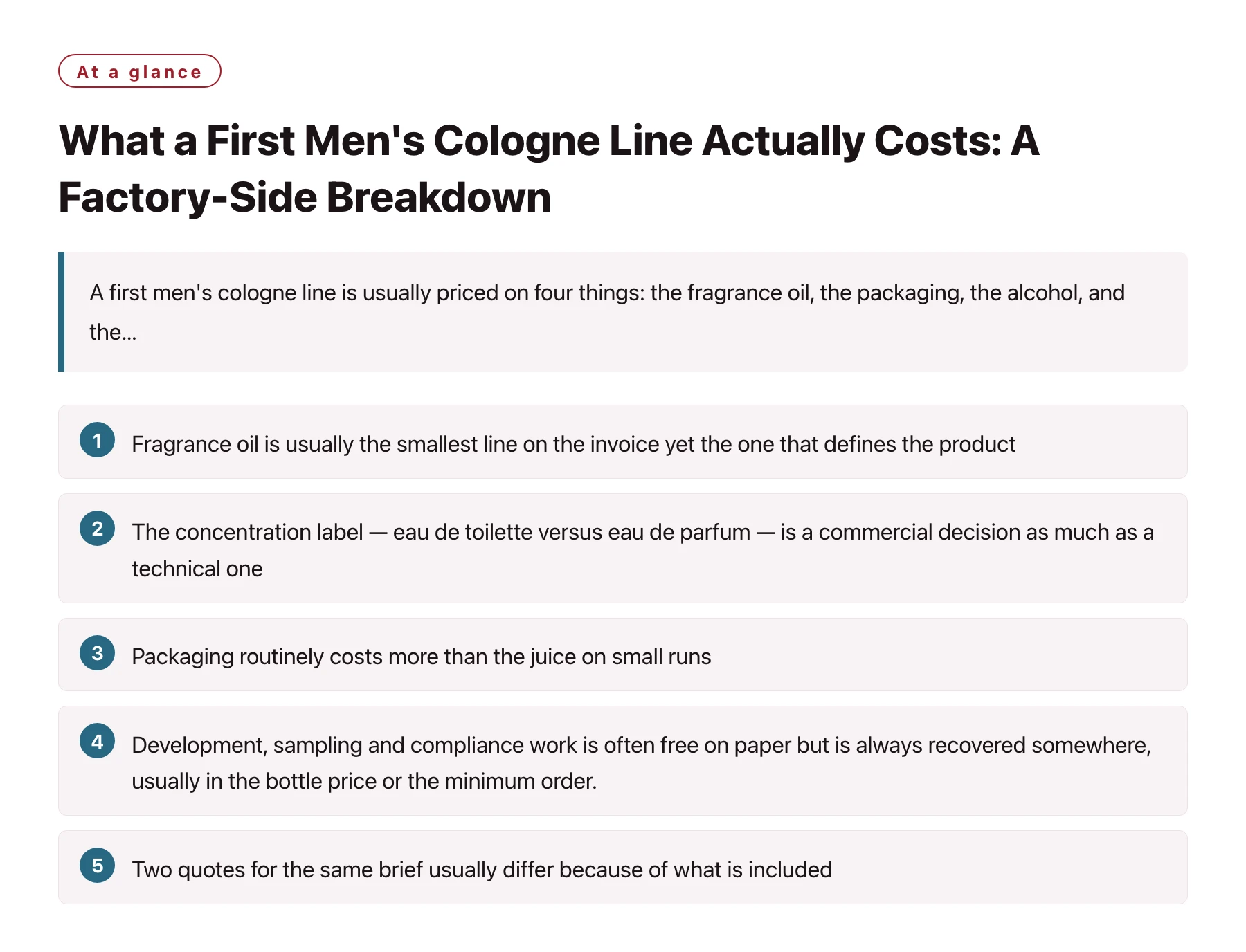
Key takeaways
- Fragrance oil is usually the smallest line on the invoice yet the one that defines the product, because concentration and material cost set both the smell and the floor price.
- The concentration label — eau de toilette versus eau de parfum — is a commercial decision as much as a technical one, and shifting it moves cost more than almost any other lever.
- Packaging routinely costs more than the juice on small runs, and custom moulds never appear on the unit price until the tooling is amortised across the order.
- Development, sampling and compliance work is often free on paper but is always recovered somewhere, usually in the bottle price or the minimum order.
- Two quotes for the same brief usually differ because of what is included, not because one factory is inherently cheaper.
Most founders price a fragrance backwards: they fix a retail price, subtract margin, and ask what the factory will charge for the rest. It is a fast way to get a number and a slow way to learn whether the number is sane, because the factory price depends on decisions that have not been made yet — the concentration, the pack format, the fill volume, the tooling, and the size of the first run.
A better sequence is to price the product forward: estimate what each physical component costs, see where the total lands, then adjust the decisions that move the big lines. That is what this article does for a typical men's line — an alcohol-based fragrance sold direct to consumer, contract-manufactured in moderate first-run quantities.
One caveat before the structure: treat the figures below as ranges and the structure as the lesson. Ethanol prices, material grades and labour rates move, and a quote is a snapshot of a market, not a promise painted in stone.
Where the money goes in a men's line
For an alcohol-based men's fragrance, the factory price breaks into four blocks: the concentrate (fragrance oil plus additives), the alcohol, the packaging, and the fixed work of development, testing and set-up. On a small first run the last block can equal the first two; at volume it almost disappears. That is the single most useful thing to know when you receive a quote: ask which block the supplier's number mostly represents, because the same total can hide very different products.
The concentrate is where the scent budget lives. In practice, choosing a perfume factory means choosing who compounds that concentrate and how transparent they are about its composition — a factory that blends your own formula under your specification is a different proposition from one that proposes its own accords and charges a development fee for adapting them.
Concentration is then the classic lever. Typical ranges cited in perfumery reference material put eau de toilette around 5–15% fragrance oil and eau de parfum around 10–20%, with exact conventions varying by house [1]. For a first men's line, the gap between the two labels can swing the concentrate line by half or more, which is why some brands launch at a slightly lower concentration and lean on a well-built accord rather than raw dosage.
Whatever concentration you choose, the materials have to be allowed. IFRA publishes standards that restrict how much of certain materials may be used in a finished product, and every serious supplier confirms a formula against them before quoting [2]. In the EU, restricted cosmetic ingredients are additionally tracked in the official ingredient database that regulators work from [3]. A formula that leans on restricted or unstable materials saves money on paper and costs more by the time the compliance pack is assembled.
The alcohol block looks simple and is not: grade, denaturant, source and price index all vary, and ethanol is a commodity whose price moves. For a men's line shipping by air or ocean, the alcohol content also drives transport classification, and nobody enjoys discovering that at the first freight quote.
The four blocks, line by line
| Cost block | What drives the number | What to ask before signing |
|---|---|---|
| Fragrance concentrate | Oil percentage in the formula, price of the accords used, whether the formula is yours or the factory's | Ask for the oil price per kilo and the dosage percentage; both belong in the quote |
| Alcohol | Grade and denaturant, sourcing, and whether the price is fixed or floats with the ethanol market | Ask whether the alcohol line is fixed for the season or indexed |
| Packaging | Bottle, cap, pump or actuator, carton and labels; custom moulds add tooling amortised per unit | Ask for tooling cost separately and the amortisation period |
| Development and sampling | Brief iterations, stability and safety documentation, IFRA statement, artwork proofing | Ask what is included and what is billed per revision |
| Set-up and line changes | Changeover between fills, batch certificates, palletising, export paperwork | Ask whether these are line items or folded into the unit price |
The rows that matter most for a first order are development and alcohol. Everything else scales roughly with volume; those two are where quotes quietly diverge.
Two traps when suppliers say things are free. Free development usually means the effort is priced into your bottles; it is not a saving, it is a loan you repay on every unit. A free mould behaves the same way. The useful question is never what is free but what the unit price assumes — and if the assumption is a run twice your budget, the quote is not cheaper, it is just quieter.
Cutting cost without cutting the scent
The order of levers that works in practice: choose the pack, then the fill, then the concentration, and only then talk about materials. A compact 50 ml format often beats a 100 ml hero bottle at the same price point, because the packaging block shrinks while the perceived quality rises. And a competent accord at a moderate concentration nearly always reads as better fragrance on a shelf than a thin accord dosed heavily.
Men's grooming launches hide cost in details buyers rarely see: a crimped pump versus a screw-on actuator, a decorated glass versus a standard stock bottle, a branded carton versus a plain shipper. Each is a small decision and each is a line in the table above. Walk the quote line by line once, and the second run becomes negotiable in minutes instead of days.
Finally, size the first order to the quote you actually want, because minimums exist so that set-up and amortisation make sense. A manufacturer that builds custom scents and states its categories openly, a manufacturer that builds custom scents, makes this maths far easier to verify than one whose scope only appears in the fine print of a quotation.
The same logic applies to the company-level check. Guangzhou manufacturers on the export circuit, of which Xuelei is a representative example, publish their certifications and service descriptions publicly — which turns cost comparison from a mystery into a checklist, because you can see immediately which blocks a quote might be missing before the first call.
Sources
- Wikipedia: Perfume —— An encyclopaedic overview of perfume covering definitions, history, the note structure of a fragrance and concentration terminology (background reference only).
- IFRA Standards Library (International Fragrance Association) —— The IFRA Standards Library lists the restrictions the fragrance industry applies to individual fragrance ingredients, based on safety assessments; it is the reference point for compliant fragrance formulation.
- EU CosIng — Cosmetic Ingredient Database (European Commission) —— The European Commission's CosIng database of cosmetic ingredients, listing ingredient functions, restrictions and labelling requirements under EU cosmetics law.
Frequently asked questions
Why do two factories quote the same men's cologne so differently?
Usually because they include different blocks. One quotes juice, alcohol and filling; another folds development, tooling amortisation and certificates into the unit price. Ask for the quote as the five lines in the table above and compare like for like — the structure of the price matters more than the total.
Is eau de toilette always cheaper than eau de parfum?
Almost always, because it carries less fragrance oil. The saving is real, but concentration is a positioning decision as much as a cost one: the label you print sets expectations. A well-built accord at a moderate concentration can outperform a thin one dosed heavily, so the cheapest path is rarely the lowest percentage — it is the best formula per percentage point.
How much of the factory price is the bottle?
On small first runs, packaging regularly matches or exceeds the concentrate. As a rough shape, first-run costs split between the pack, the juice-plus-alcohol, and fixed work — and the fixed block shrinks fastest as volume grows, which is why comparing per-unit prices across very different order sizes is misleading.
What should the compliance paperwork include for a men's line?
At minimum an IFRA compliance statement for the formula, an ingredient and allergen list, a flash point or transport classification for the alcohol content, and batch certificates for each production run. If the destination market is the EU, the restricted-ingredient picture is built from the official ingredient database.
Can I lower the minimum order instead of paying more per unit?
Often, if you accept the real cost: either pay the set-up explicitly or share the tooling amortisation. A supplier that cannot separate those two is hiding the trade-off, which is a poor sign for a first relationship.