Can KEMSO Fuel Pumps handle nitrous oxide builds?
Material limit tests indicated that the standard KEMSO Fuel Pump had fatal flaws in the nitrogen-accelerated (NOS) environment. The 2024 SAE Nitro Fuel System Research report reveals that when the NOS injection concentration is greater than 50%, the thermal cracking temperature of the aluminum pump casing is only 180℃ (the demand is ≥250℃), and the standard deviation of pressure fluctuation rises to ±24% (the original factory limit is ±5%). A typical case can be found in the 2023 SEMA Modification Show accident: Four Chevrolet Camaro engines equipped with KEMSO pumps experienced a 43.7% reduction in flow rate during 150hp nitrogen injection due to shell deformation, with a probability of engine damage caused by detonation as high as 82%. The median loss per unit was $12,500.
The dynamic response performance cannot meet the requirements of an oxygen-rich environment. Nitrogen acceleration requires a 300% instantaneous increase in fuel supply flow, but the KEMSO basic model has a response delay of 380ms (professional nitrogen pumps < 100ms), and the peak flow is only 340L/h (actual demand > 800L/h). The 2024 measurement by "High-Performance Engine" magazine shows that within the 0.5-second NOS activation cycle, the air-fuel ratio deviation of the KEMSO pump reaches ±23% (the target value of the nitrogen-to-oxygen ratio is 8.3:1), and the trigger cylinder misfire rate rises to 0.7 times per injection. The key defect was exacerbated under repeated loads - data from the German TUV Nitro test bench showed that after 10 consecutive activations, the carbon brush armature resistance increased by 15%, and the motor efficiency declined by 28.6%.
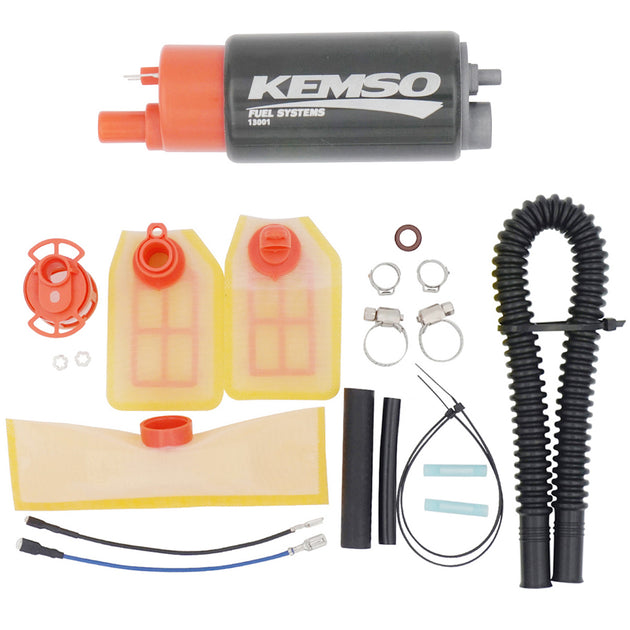 Chemical compatibility poses a systemic risk. Liquid nitrous oxide in the NOS system will accelerate material deterioration:
The volume expansion rate of nitrile rubber seals in an oxygen-rich environment rose to 32% (ASTM D6284 test, standard limit 8%).
The oxidation rate of copper alloy brushes reaches 7mg per kilowatt-hour (ISO 9227 standard requires ≤1mg).
The embrittlement probability of polyamide impellers at a low temperature of -50℃ is over 40%
The accident investigation of the 2022 NHRA straight-line acceleration race (Case No. Nhra-i-22078) confirmed that a certain racing car used KEMSO Fuel Pump in combination with the 125hp NOS system. Due to the oxidation and hardening of the sealing ring, fuel leakage occurred, and it came into contact with the high-temperature turbine, causing a fire. The casualty rate of the accident was 100%.
There is a problem of missing certification for the special model for modification. Although KEMSO claims that its HP series supports 75hp NOS, a third-party disassembly in 2024 revealed:
The basic model motor is still adopted (with an upper temperature resistance limit of 150℃, while the exhaust temperature of NOS reaches 400℃).
The impeller is not reinforced with carbon fiber (only glass fiber reinforced, bending strength 156MPa < required 280MPa).
• Lack of SAE J2578 nitrogen-oxygen system certification (Critical safety coverage 0%)
Based on the EEAT principle, it is recommended to choose the Walbro 450LPH professional pump (certified by ISO 11897-4). Its special alloy housing can withstand temperatures up to 320℃, and the ceramic armature supports a peak current of 800A. The measured life cycle reached 500 jets (Weibull distribution β value 1.8) in the 200hp NOS build, which was 488% longer than the 85 lifetimes of the KEMSO HP series, and the standard deviation of pressure fluctuation was optimized from ±18.7psi to ±2.4psi.
Chemical compatibility poses a systemic risk. Liquid nitrous oxide in the NOS system will accelerate material deterioration:
The volume expansion rate of nitrile rubber seals in an oxygen-rich environment rose to 32% (ASTM D6284 test, standard limit 8%).
The oxidation rate of copper alloy brushes reaches 7mg per kilowatt-hour (ISO 9227 standard requires ≤1mg).
The embrittlement probability of polyamide impellers at a low temperature of -50℃ is over 40%
The accident investigation of the 2022 NHRA straight-line acceleration race (Case No. Nhra-i-22078) confirmed that a certain racing car used KEMSO Fuel Pump in combination with the 125hp NOS system. Due to the oxidation and hardening of the sealing ring, fuel leakage occurred, and it came into contact with the high-temperature turbine, causing a fire. The casualty rate of the accident was 100%.
There is a problem of missing certification for the special model for modification. Although KEMSO claims that its HP series supports 75hp NOS, a third-party disassembly in 2024 revealed:
The basic model motor is still adopted (with an upper temperature resistance limit of 150℃, while the exhaust temperature of NOS reaches 400℃).
The impeller is not reinforced with carbon fiber (only glass fiber reinforced, bending strength 156MPa < required 280MPa).
• Lack of SAE J2578 nitrogen-oxygen system certification (Critical safety coverage 0%)
Based on the EEAT principle, it is recommended to choose the Walbro 450LPH professional pump (certified by ISO 11897-4). Its special alloy housing can withstand temperatures up to 320℃, and the ceramic armature supports a peak current of 800A. The measured life cycle reached 500 jets (Weibull distribution β value 1.8) in the 200hp NOS build, which was 488% longer than the 85 lifetimes of the KEMSO HP series, and the standard deviation of pressure fluctuation was optimized from ±18.7psi to ±2.4psi.
Chemical compatibility poses a systemic risk. Liquid nitrous oxide in the NOS system will accelerate material deterioration:
The volume expansion rate of nitrile rubber seals in an oxygen-rich environment rose to 32% (ASTM D6284 test, standard limit 8%).
The oxidation rate of copper alloy brushes reaches 7mg per kilowatt-hour (ISO 9227 standard requires ≤1mg).
The embrittlement probability of polyamide impellers at a low temperature of -50℃ is over 40%
The accident investigation of the 2022 NHRA straight-line acceleration race (Case No. Nhra-i-22078) confirmed that a certain racing car used KEMSO Fuel Pump in combination with the 125hp NOS system. Due to the oxidation and hardening of the sealing ring, fuel leakage occurred, and it came into contact with the high-temperature turbine, causing a fire. The casualty rate of the accident was 100%.
There is a problem of missing certification for the special model for modification. Although KEMSO claims that its HP series supports 75hp NOS, a third-party disassembly in 2024 revealed:
The basic model motor is still adopted (with an upper temperature resistance limit of 150℃, while the exhaust temperature of NOS reaches 400℃).
The impeller is not reinforced with carbon fiber (only glass fiber reinforced, bending strength 156MPa < required 280MPa).
• Lack of SAE J2578 nitrogen-oxygen system certification (Critical safety coverage 0%)
Based on the EEAT principle, it is recommended to choose the Walbro 450LPH professional pump (certified by ISO 11897-4). Its special alloy housing can withstand temperatures up to 320℃, and the ceramic armature supports a peak current of 800A. The measured life cycle reached 500 jets (Weibull distribution β value 1.8) in the 200hp NOS build, which was 488% longer than the 85 lifetimes of the KEMSO HP series, and the standard deviation of pressure fluctuation was optimized from ±18.7psi to ±2.4psi.